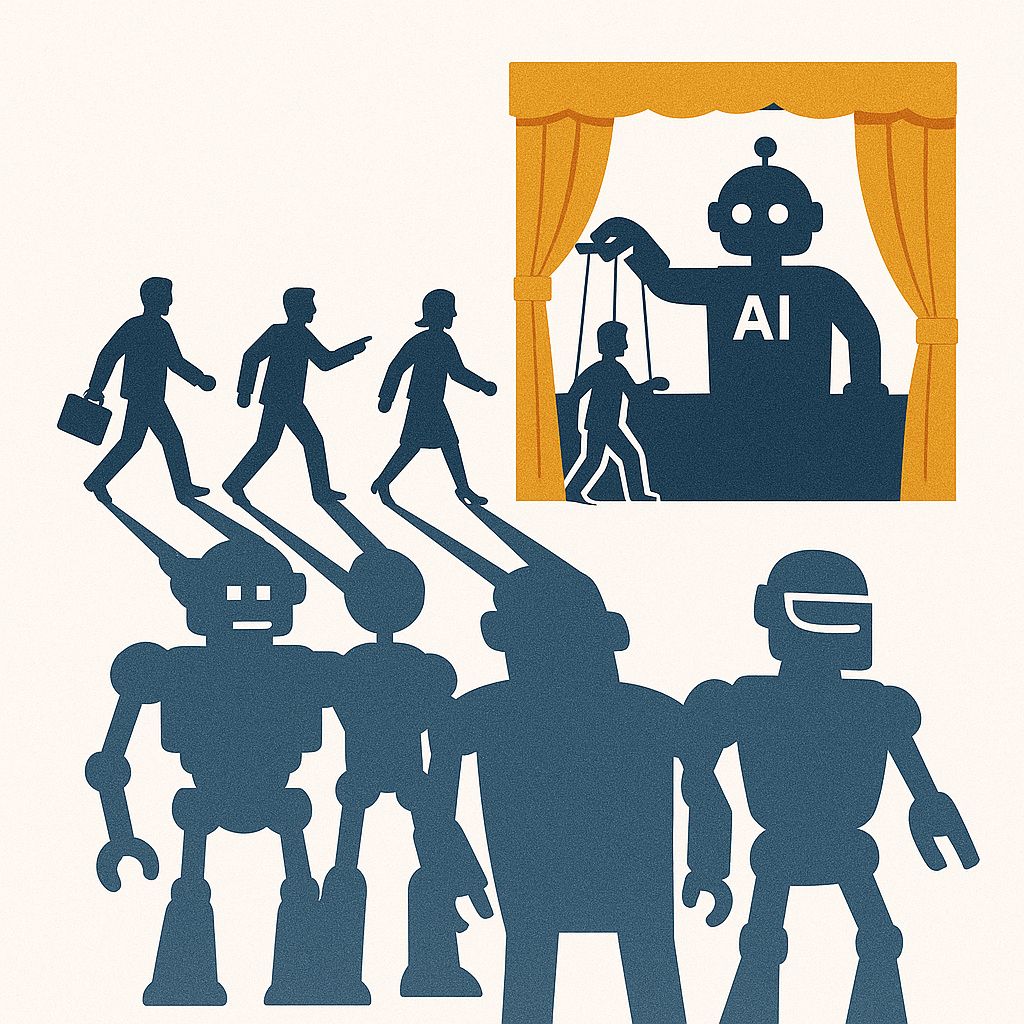
Most companies are spending a fortune on AI. Here’s why wise leaders are waiting.
In 18 months, AI has moved from being just a technology interest to a major focus for businesses. CEOs who didn’t know about neural networks now talk about ‘transformer models’ in meetings. McKinsey says AI could add £2-3.5 trillion a year to the global economy¹. Nvidia, which makes the chips for AI, is now valued at £3.1 trillion: more than the entire UK economy².
But the evidence shows this AI frenzy is mostly hype. We’ve seen this before with dotcom shares in 1999 and blockchain in 2017. When everyone thinks a technology will change everything, it usually changes far less than we expect and costs more than anyone planned.
The Numbers Don’t Add Up
Companies are throwing money at AI without thinking it through. Venture capital funding for AI firms hit £80 billion in 2024, up 80% from 2023³. Businesses are hiring ‘Chief AI Officers’ on high salaries and spending billions on ‘AI transformation’ projects that no one can properly measure.
This isn’t just happening in technology companies. Banks, manufacturers, retailers, and hospitals are all betting their futures on AI. Fear of missing out has replaced common sense.
Remove the marketing fluff, and most AI does simple things: finding fraud, recommending products, making simple tasks easier. Helpful, yes. Groundbreaking? Not really. Many ‘AI-powered’ products are just regular software with some machine learning added.
Look at Banks. AI trading systems analyse data quicker than people, but they haven’t made markets steadier or outperformed basic index funds over time. Some studies even indicate AI trading might make markets less efficient⁴. The top AI hedge funds have high fees but provide average returns.
Why AI Is Getting Harder, Not Easier
The maths behind AI development shows that the technology may be facing limits. Large language models like GPT-4 get better with size, but each upgrade now requires much more computer power, data, and energy.
Training GPT-4 cost more than £80 million. Google’s Gemini Ultra cost £150 million⁵. Running these systems needs data centres that use as much power as small cities. Only the largest technology companies can keep up with this arms race, which means most firms building their own AI systems are wasting their money.
The job market is crazy. AI engineers and top researchers are earning high salaries⁶. Companies are hiring entire AI teams before they know what problems they want to solve. A recent Gartner survey found that 92% of IT directors thought their companies would use AI by 2025, but most couldn’t show it’s worth the money⁷.
One big issue is this: most AI experts come from academia, where they mainly work on science instead of fixing business problems. They are great at improving algorithms but poor at cleaning data, connecting systems, and managing change: the dull tasks that are really important.
What Smart Companies Do Instead
Don’t lose business focus and chase AI for its own sake. Treat AI investments with the same careful thought as any big spending decision.
Focus on the problem, not on the technology. The best AI projects tackle clear business issues where it is better than current methods. Consider if you really need AI. Many problems are solved better with existing techniques, better processes, or simple automation.
First, check your data. AI systems require good, reliable data to function. Many companies find out too late that their data is too disorganized, incomplete, or scattered to enable effective AI uses.
Look at the total cost, not just the initial development. AI systems require ongoing maintenance, retraining, investment in infrastructure, and expert staff. These ongoing costs can often be higher than the initial development budget.
For most companies, buying AI capabilities is smarter than building them. Unless AI is key to your edge over competitors, getting solutions from expert providers usually provides better results than creating your own systems.
The Patient Approach Wins
While others hurry into AI projects, shrewd leaders can create lasting benefits by taking a careful approach. History shows that companies which wait for technologies to develop while strengthening their skills often avoid the costs and risks that early adopters encounter.
Pay attention to basics while others seek attention. Companies that build data systems, analysis skills, and decision-making methods will be in a better place when AI develops and costs drop.
Think about working with partners instead of developing everything yourself. Collaborating with AI companies or research organisations lets you use advanced tools without the high costs and risks of creating your own systems.
When the Bubble Bursts
Market signals show that AI valuations are unrealistic. When companies can increase their share price just by announcing AI initiatives, when startups get funding based on founder CVs rather than business plans, when traditional industries restructure around AI without solid plans: these are classic signs of a bubble.
And the results are familiar too. Overhyped apps will not deliver what was promised. Venture funding will dry up. Companies that depend solely on AI will struggle to change their strategies.
The companies that thrive after the hype will be those that create lasting competitive advantages that AI can improve but that they aren’t reliant on. They’ll tackle real business issues with the right technology instead of using complex AI for problems that don’t require it.
This doesn’t mean we should ignore AI. The technology will be important for the global economy. But changes rarely happen as easily or fast as people first think. They usually have false starts, unexpected problems, and results that are quite different from what was originally expected.
The companies that will gain the most from AI are probably not the ones making the biggest fuss about it now. They are quietly setting themselves up to use AI well when it becomes a trustworthy and affordable business tool instead of a costly experiment.
The AI revolution might come. But wise leaders will get ready for it without betting everything on its quick arrival. The best plan might be the simplest: fix real issues with the right tools, develop skills step by step, and avoid chasing every new technology trend.
The excitement about AI will eventually fade. How well your organisation does in the future depends on the decisions you make now.
Sources:
- McKinsey & Company. “The economic potential of generative AI: The next productivity frontier.” June 2023.
- The Economic Times. “How Jensen Huang’s NVIDIA became the world’s most valuable firm, bigger than UK’s GDP.” July 4, 2025.
- Our World in Data. “Annual private investment in artificial intelligence.” April 18, 2025.
- Nasdaq. “Artificial Intelligence: What to expect in 2025.” June 26, 2025.
- Ankit Shah. “Navigating the LLM Cost Maze: A Q2 2025 Analysis.” Medium. April 11, 2025.
- Refonte Learning. “AI Engineering Salary Guide 2025.” February 26, 2025.
- Gartner. “CIO Challenges for 2024-2025.”


Leave a Reply