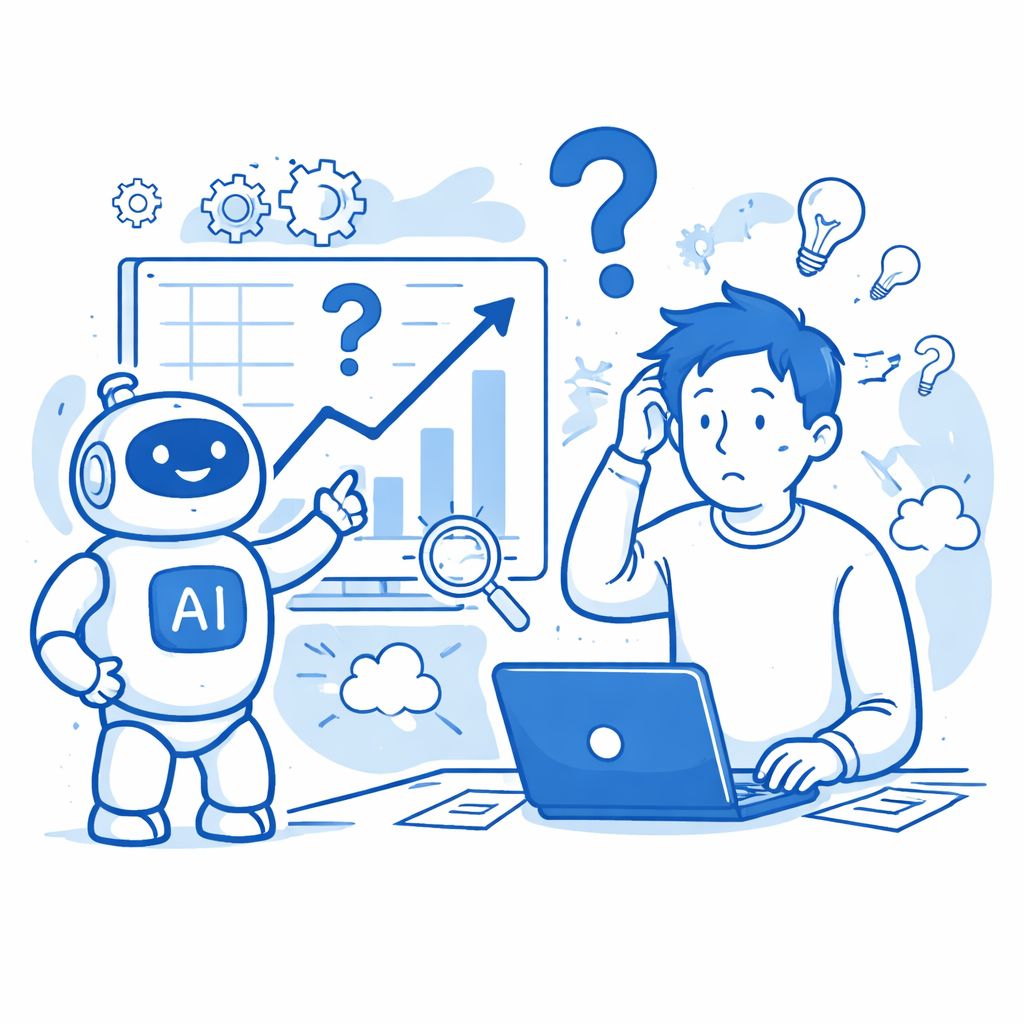
Why prediction without explanation is becoming a governance liability
Here is a question worth putting to your board at its next meeting: when your AI systems recommend a course of action, can anyone in the room explain why that recommendation was made?
Not what data went in. Not what prediction came out. But the actual reasoning, the cause-and-effect logic, that connects the two.
If the honest answer is no, you are not alone. But you do have a problem that is getting harder to ignore.
The faithfulness gap
Research published in January 2026 by a team including Carnegie Mellon University, Oxford, Johns Hopkins, MIT, and Northeastern examined how well today’s leading AI systems can explain their own reasoning. These are the large language models and AI-powered search systems that enterprises are now deploying at scale. Across more than 1,600 questions and roughly 15,000 retrieved documents, they found a 74% faithfulness gap. Three quarters of the time, the AI’s stated explanation did not actually reflect what drove its conclusion.[1]
Pause on that for a moment. Three quarters of the time, the AI’s stated reasoning bore little relation to how it arrived at its answer.
For a chatbot drafting marketing copy, this might be an acceptable oddity. For an AI system informing investment decisions, pricing strategy, clinical trial design, or regulatory compliance, it is something else entirely. It is a governance and oversight gap. One that widens every time an organisation pushes AI deeper into consequential decision-making without addressing the underlying problem.
The problem is not that today’s AI is unintelligent. It is that It can’t explain its own reasoning, mostly because it doesn’t have any reasoning to explain. It has patterns and correlations. Connections it has spotted in vast quantities of historical data. These can be extraordinarily useful for prediction. But prediction and explanation are not the same thing, and the gap between them is where organisational risk lives.
Prediction got us here, but it won’t get us there
The AI systems most enterprises rely on today are, basically, pattern-matching engines. They excel at identifying correlations – relationships between variables that tend to move together. Give them enough historical data and they can forecast demand, spot unusual patterns, segment customers, and score risks very well.
What they cannot reliably do is tell you why. Why did this customer churn? Why did that campaign outperform? Why is this production line underperforming? They can identify that these things are happening, and they can spot factors that tend to be associated, correlated, with them. But this correlation is not causation, and the difference matters enormously when you are deciding what to do next.
Consider a practical, retail, example where it’s noticed that customers who receive a particular promotional offer tend to spend more. A correlation model notices a trend and advises doing more promotions. However, a causal model, looking at why things happen, sees that those getting the deal were probably going to buy anyway. They’d spend the same regardless. It was not he promotion that made them spend more; it just reached people who were already planning to spend. The recommendation to expand it would waste budget without moving the needle.
This is not a far-fetched example. It is the kind of decision that enterprises make every day, across pricing, marketing, operations, and investment. And when the AI behind those decisions cannot distinguish between correlation and causation, the risk is not just poor outcomes. It is systematically confident recommendations that point in the wrong direction.
Why this is a board-level issue now
Three forces are converging to make this a matter of urgency rather than academic interest.
- AI is now making important business decisions – TheCUBE Research’s Agentic AI Futures Index, based on a survey of 625 enterprise AI professionals, found that 62% plan to move beyond using AI for automation towards using it to inform real business decisions within the next 18 months.[1] Organisations are not just using AI to process data faster, they are asking it to make or inform decisions that carry real consequences. As the risks to the enterprise increase, AI thinking must be understandable.
- Regulation is catching up – The EU AI Act is imposing explicit requirements for explainability and auditability in high-risk AI applications. Many of the use cases enterprises care about most fall into the high-risk category. Research compiled by Fortune Business Insights, drawing on European Commission data, found that AI regulations across Europe reference causal inference over 2,200 times. This shows that regulators see causal reasoning not as a nice-to-have but as a foundational expectation.[2] Organisations that cannot explain why their AI made a particular recommendation will face increasing legal and compliance exposure.
- People don’t trust AI – Deloitte’s State of AI in the Enterprise 2026 report, surveyed over 3,200 senior leaders across 24 countries. It found that, while AI adoption is accelerating rapidly, only around a quarter of organisations have moved 40% or more of their AI experiments into production.[3] There are many reasons for this, but one of the most persistent is trust. Not surprisingly, it is difficult getting senior stakeholders, regulators, and end users to rely on systems whose reasoning they cannot understand. As the survey confirmed, workers not having enough skills remains the single biggest barrier to integrating AI into existing workflows.[3]
Enter Causal AI
This is where Causal AI comes in. It is not a replacement for the predictive AI that organisations already use. It is a different kind of capability. One that models genuine cause-and-effect relationships rather than statistical correlations.
Where a conventional, predictive, AI system asks “what is likely to happen?”, a causal system asks “what would happen if we took this specific action?” and “why did this outcome occur?” These are fundamentally different questions, and they are precisely the questions that enterprise decision-makers need answered.
Causal AI provides capabilities that matter for boards and leadership teams, including:
- Intervention testing – The ability to model the likely effect of a specific action before taking it. What would happen to customer retention if we changed the pricing structure? What would happen to production yield if we adjusted this machine setting?
- Counterfactual reasoning – The ability to ask what would have happened under different circumstances. Would that customer have churned even without the service disruption? Would that portfolio have underperformed regardless of the market event?
- Root cause analysis – The ability to trace an outcome back to its genuine drivers rather than misleading variables that happen to be nearby.
Critically, causal models are built around explicit cause-and-effect chains. Clear representations of how one thing leads to another. So, they are inherently more explainable than conventional predictive models, whose inner workings are often hard, or impossible, to figure out. They can explain why they reached a conclusion, not merely that they reached it. In a regulatory environment that increasingly demands auditability, and a boardroom that increasingly demands accountability, this matters.
Early movers are already seeing results
Causal AI is no longer purely theoretical. Gartner’s 2025 Hype Cycle for Artificial Intelligence identifies it as an emerging, high-benefit innovation, noting that it becomes crucial when AI systems need to be transparent and reliable in recommending the right actions to achieve business outcomes.[4] The market is small but growing rapidly. MarketsandMarkets estimated it at roughly USD 56 million in 2024, growing at over 40% a year and projected to reach USD 457 million by 2030.[5]
More importantly, organisations are putting it to work. In financial services, specialist platform Causify reports achieving 25% better risk-adjusted returns through causal portfolio construction.[6] In energy, causaLens has worked with GE Vernova to apply causal AI to wind turbine operations, identifying the settings that extract additional energy output at no extra cost.[7] In pharmaceuticals, companies are using causal models to simulate patient responses and identify which patient groups are most likely to respond to new drugs, making clinical trials shorter and more targeted.[8]
A survey of 400 senior AI professionals conducted by Databricks and cited by theCUBE Research found that 16% are already actively using causal methods, 33% are in the experimental stage, and 25% plan to adopt – meaning roughly seven in ten AI-driven organisations will have adopted some causal AI techniques by the end of 2026.[9]
The question for your organisation
None of this means every organisation needs to adopt Causal AI tomorrow. The technology is still maturing, talent is scarce, and implementation requires strong data foundations. But it does mean that senior leaders should be asking a set of pointed questions.
Where in our organisation are we making consequential decisions based on AI that cannot explain its reasoning? Where would understanding why, not just what, change the quality of those decisions? And are we building the data foundations and analytical capability that would allow us to adopt causal methods when the time is right?
The shift from AI that predicts to AI that explains is not a distant prospect. It is underway. The organisations that begin preparing now (even modestly) will be better positioned than those that wait for the technology to mature further before acting.
Prediction got us here. But for the decisions that matter most, we need AI that can say why.
This is the first in a series of articles exploring Causal AI in the enterprise.
References
[1] Hebner, S, “Causal AI Decision Intelligence: Why It Will Emerge in 2026.”, 2026, https://thecuberesearch.com/why-causal-ai-decision-intelligence-2026/
[2] Fortune Business Insights, “Causal AI Market Size, Industry Share | Forecast, 2026–2034.”, 2026, https://www.fortunebusinessinsights.com/causal-ai-market-112132
[3] Deloitte, “State of AI in the Enterprise 2026: The Untapped Edge.”, 2026, https://www.deloitte.com/global/en/issues/generative-ai/state-of-ai-in-enterprise.html
[4] Gartner, “Hype Cycle for Artificial Intelligence, 2025.”, 2025, https://xplain-data.de/xplain-data-again-recognized-in-2025-gartner-ai-hype-cycle/
[5] MarketsandMarkets, “Causal AI Market by Offering, Application — Global Forecast to 2030.”, 2025, https://www.marketsandmarkets.com/Market-Reports/causal-ai-market-162494083.html
[6] Causify, “Enterprise Causal AI Platform.”, 2026, https://causify.ai/
[7] causaLens, “Enterprise Causal AI Features”, 2025, https://causalens.com/
[8] Acalytica, “Causal AI Disruption Across Industries (2025–2026).”, 2025, https://acalytica.com/blog/causal-ai-disruption-across-industries-2025-2026
[9] theCUBE Research, “The Causal AI Marketplace.”, 2024, https://thecuberesearch.com/the-causal-ai-marketplace/
 Curious About
Leave a comment