Why the Smartest Writers Use the Simplest Words
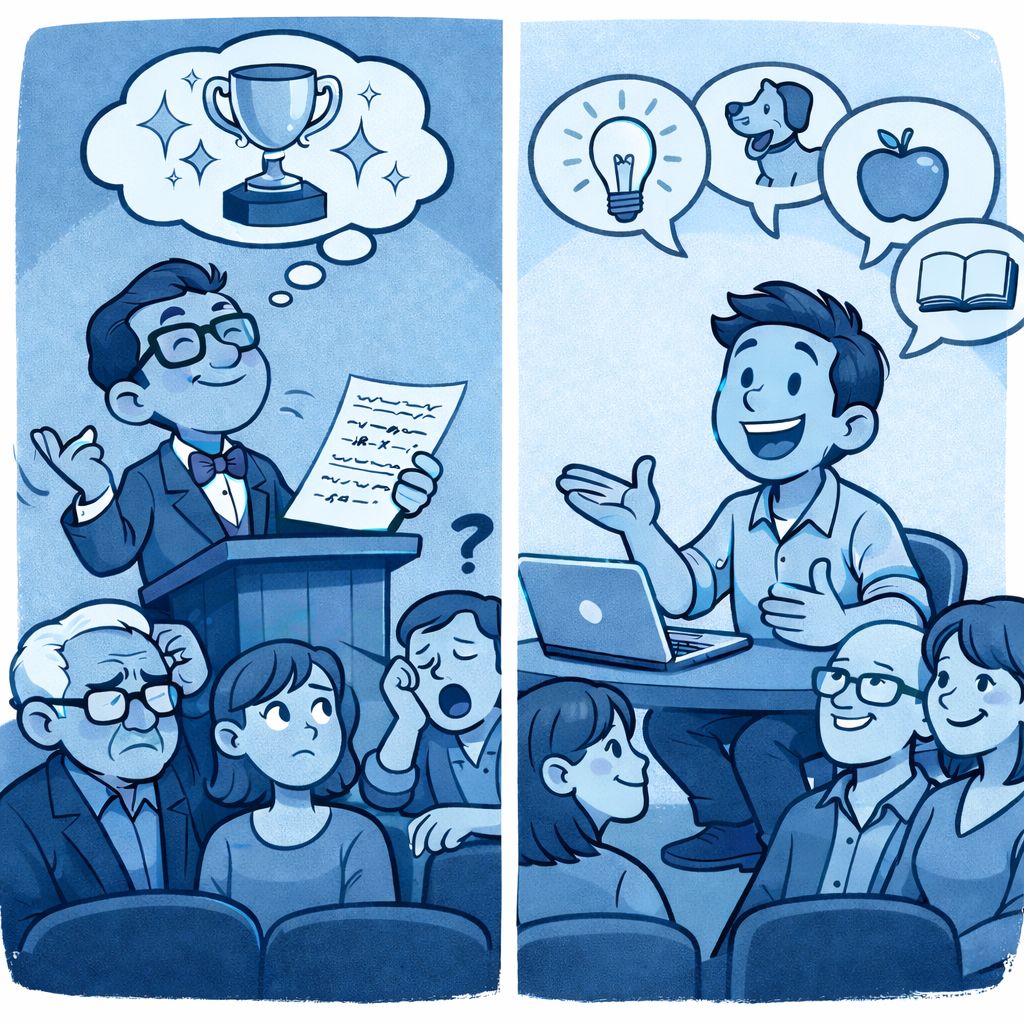
There’s a belief that just won’t die. It lurks in boardrooms, law firms, universities, analyst firms, and government departments. It whispers: if you want to sound smart, use big words.
It’s wrong. And there’s a mountain of evidence to prove it.
Big words make you look less intelligent, not more
In 2006, a psychologist at Princeton University called Daniel Oppenheimer published a study with a deliberately ironic title: “Consequences of Erudite Vernacular Utilized Irrespective of Necessity.” Across five experiments, he found that readers consistently rated writers who used simpler language as more intelligent than those who reached for the thesaurus [1].
When he took graduate admissions essays and swapped in longer synonyms, the applicants were judged as less impressive. When he simplified the language, perceived intelligence went up. Every time.
The reason? Something called processing fluency. When text is easy to read, we feel good about it, and we transfer that positive feeling onto the writer. When text is hard going, we assume the writer is confused, or trying too hard.
When Oppenheimer surveyed students, 86% admitted to deliberately making their writing more complex to seem smarter. They were doing the exact opposite of what works [1].
Everyone prefers plain language – especially experts
Professor Chris Trudeau at Western Michigan University ran the first empirical study in the US on public preferences for plain language. When people were given a choice between a sentence written using legal language and a plain English version, roughly 80% chose the plain version. And the more complex the subject, the stronger the preference. A full 97% of respondents preferred “among other things” over the Latin “inter alia” [2].
Trudeau later expanded this into an international study across the US, UK, Canada, Australia, and New Zealand. Same result, everywhere [3].
But surely specialists are different? Surely doctors, lawyers, and engineers want the technical language?
No. The Nielsen Norman Group, one of the world’s leading user experience research organisations, tested this directly. Their conclusion was that even highly educated readers want succinct, scannable information – just like everyone else [4]. The UK Government’s own research backs this up. As the GOV.UK writing guidelines put it: “The more educated the person and the more specialist their knowledge, the greater their preference for plain English.” [7]
This makes sense when you think about it. Experts have the most to read. They’re the people who benefit most from writing that gets to the point.
The cost of getting it wrong
This isn’t just about preference. Unclear writing costs real money and causes real harm.
Professor Joseph Kimble compiled over 50 case studies in his book Writing for Dollars, Writing to Please. One example: when the US Veterans Benefits Administration rewrote a single letter in plain English, phone calls about that letter dropped from 1,110 to about 200. One letter. One office. The Cleveland Clinic simplified a billing statement and recovered an additional $1 million per month [9].
When we write in needlessly complicated language, we’re not just being inefficient. We’re locking millions of people out of understanding their rights, their health information, and the services available to them.
The digital world makes it essential
Jakob Nielsen established back in 1997 that people don’t read web pages -they scan them. On an average visit, users read at most 28% of the words on a page. Realistically, it’s closer to 20% [6].
On mobile, comprehension drops further [5]. And most of us are now reading on our phones.
If your writing assumes a patient reader sitting at a desk with a cup of tea, you’re writing for a world that no longer exists. Today, if people can’t understand your message at a glance, they leave. They don’t struggle through. They go somewhere clearer.
It’s becoming the law
The US Plain Writing Act of 2010 requires all federal agencies to write public documents in plain language [8]. There are now over 998 plain language laws across the United States [10]. The UK Government has made plain English mandatory for GOV.UK [7]. Canada, Australia, New Zealand, and South Africa have all passed or proposed similar legislation. An international ISO standard for plain language was released in 2023 (ISO 24495-1:2023).
This isn’t a trend. It’s a shift.
It’s not just words
Everything in this post applies to visuals too. Charts, infographics, diagrams, icons – if your audience can’t understand them at a glance, they’re not doing their job.
A graph crammed with data points and tiny labels is the visual equivalent of a sentence stuffed with jargon. A slide deck full of complex diagrams that only make sense to the person who made them is just as confusing as unclear writing. The same principle holds: know your audience, strip away what’s unnecessary, and make the important thing obvious.
If you’re using a chart, label it clearly. If you’re using colour to convey meaning, check it works for people with colour vision deficiency. If you’re using an infographic, ask yourself: could someone unfamiliar with this topic understand the key message in five seconds? If not, simplify.
Plain language is a mindset, not just a writing style. It applies to every way you communicate – words, visuals, and design.
So what should you actually do?
A few principles that the research consistently supports:
- Know your reader. Before you write, ask: who is this for, and what do they need?
- Use short sentences. Aim for 15–20 words on average.
- Choose simple words. E.g. “Buy” not “purchase.” “Help” not “assist.” “About” not “approximately.”
- Use active voice. E.g. “We will send you a letter” not “a letter will be sent.”
- Put the important thing first. Don’t bury the point.
- Cut ruthlessly. If a word isn’t earning its place, remove it.
- Test with real people. Ask five non-specialists to read it. If they strugg.le, rewrite.
Final thoughts
Writing plainly is not dumbing down. It’s the opposite. It takes more thought, more discipline, and more respect for your reader. It’s harder than hiding behind jargon – and it’s infinitely more effective.
The research is clear [1, 2, 3] The law is moving in this direction [8, 10]. And your readers, all of them, from graduates to experts to the general public – will thank you for it [4, 5].
Write simply. Write clearly. Put the reader first.
It really is that straightforward!
References
[1] Oppenheimer, D. M. (2006) ‘Consequences of Erudite Vernacular Utilized Irrespective of Necessity.’
[2] Trudeau, C. R. (2012) ‘The Public Speaks: An Empirical Study of Legal Communication.’
[3] Trudeau, C. R. and Cawthorne, C. (2017) ‘The Public Speaks, Again: An International Study of Legal Communication.’
[4] Nielsen Norman Group (2017) ‘Plain Language For Everyone, Even Experts.’
[5] Nielsen Norman Group (2015) ‘Legibility, Readability, and Comprehension: Making Users Read Your Words.’
[6] Nielsen, J. (2008) ‘How Little Do Users Read?’
[7] Government Digital Service (2023) ‘Content Design: Writing for GOV.UK.’
[8] Plain Writing Act of 2010, Pub. L. 111–274.
[9] Kimble, J. (2012) Writing for Dollars, Writing to Please.
[10] National Association of Attorneys General (2023) ‘Plain Language: Lawmakers’ Preferred Solution.’
 Curious About
Leave a comment